Europe, part 1: Berlin in December
Trip: Berlin, Germany · December 12–20, 2025 · first stop of a three-country European trip
Last December I finally made it to Europe. The trip ended up spanning three countries — Germany, Spain, and Italy — and I’m writing it up in three parts. This is part one: Berlin, which was the strangest leg of the three, because it wasn’t really a vacation at all.
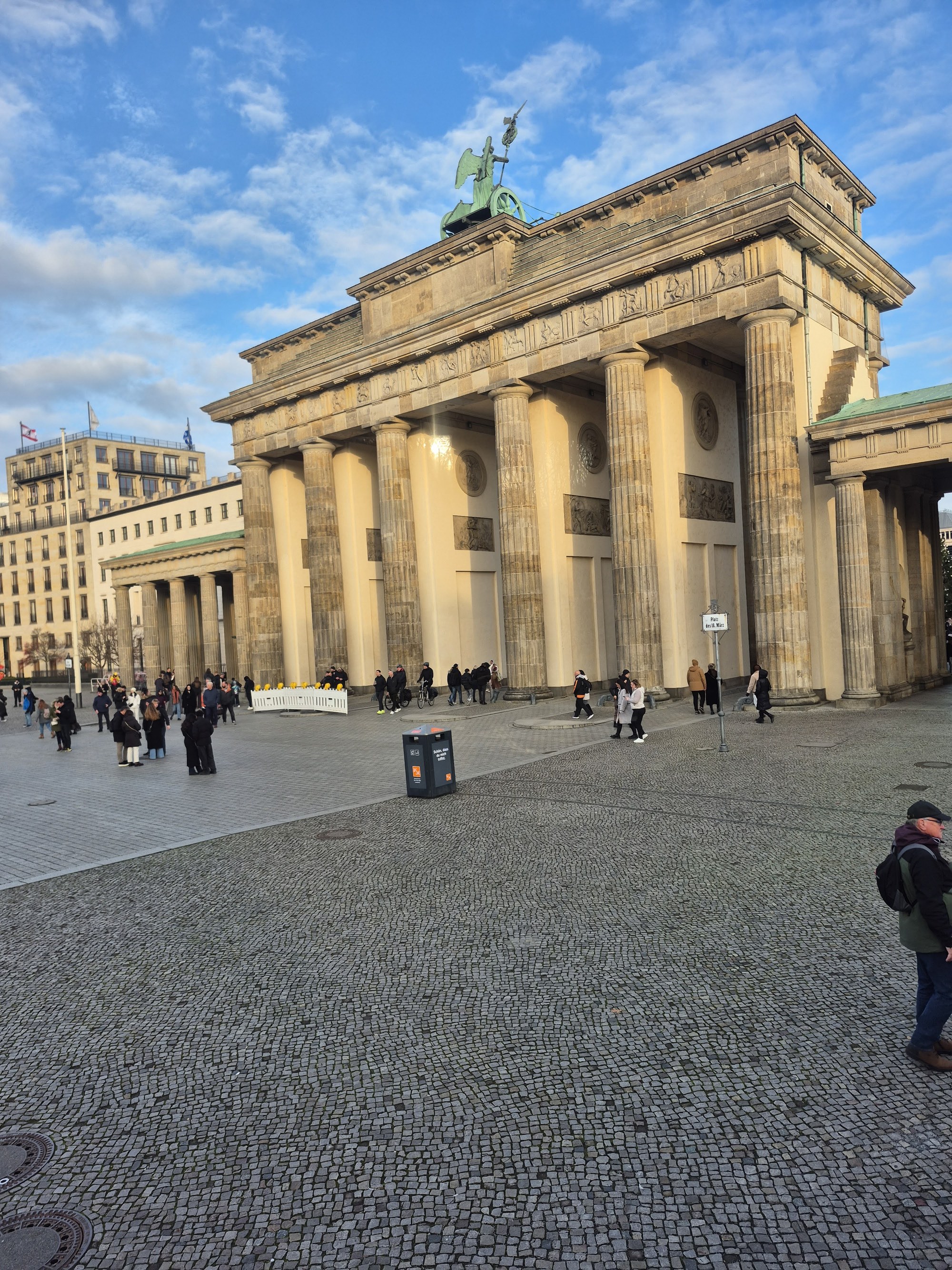
The Brandenburg Gate on a clear December afternoon. (The East Side Gallery didn’t make it into my camera roll.)
The work-trip reality
I flew JFK → Amsterdam → Berlin with a colleague, and the honest truth about the first half of the trip is that it was dominated by work. We were there partly to co-work with a collaborator at his co-working space, and the days looked like this: up at 7:30 AM, work until 9 PM, collapse. Day one we booked a hop-on-hop-off bus tour and were both too sleepy to actually get off the bus. On the Sunday I worked until noon, took a nap, and woke at 5 PM to find it already dark — December in Berlin gives you about seven and a half hours of usable daylight, and I’d slept through most of them.
By day four I had a realisation I’ve kept coming back to since: company-sponsored travel is not travel. The company is paying, which means the company (reasonably!) wants you working. If you tell yourself you’ll “explore in the evenings,” December-in-Berlin will laugh at you. If you want to actually see a place, budget your own days for it.
What German work culture taught me anyway
Ironically, the thing Berlin taught me most clearly was how to stop working. People there disconnect completely — nobody replies to Slack after hours; they’re at the pub. Sitting in a pub one evening with my colleagues, this came up explicitly, and it stuck with me. Coming from a New York startup, where the default is always-on, watching an entire society treat evenings as genuinely off was quietly radical.
The fashion was its own culture lesson: deliberately chosen secondhand clothes, a punky thrift-store style where a great jacket costs five euros. Nothing about it reads as “cheap” — it reads as chosen. Very different from New York.
A city that refuses to forget
Once the work thinned out, I got to the part of Berlin that actually moved me. Berlin is not a “top 10 attractions” city — it’s a city organised around remembering things most cities would rather bury:
- The Berlin Wall and the East Side Gallery — including the famous mural of the two presidents kissing. Walking a former death strip that’s now an open-air art gallery is a strange, hopeful feeling.
- The DDR Museum — daily life in East Germany, down to the furniture and the surveillance. I hadn’t understood viscerally what living under that system meant until this.
- The Holocaust Memorial and the Topography of Terror — sobering, deliberately so. What struck me is that Germany built these on purpose, in the middle of its capital. The country institutionalised confronting its own worst history.
- The TV Tower — the tallest structure in Berlin, and a good way to get the city’s scale.
We stayed in Friedrichshain, which felt like “the Lower East Side of East Berlin” — the RAW-Gelände complex nearby is a reused industrial site full of clubs and street art, very much post-wall youth-rebellion energy.
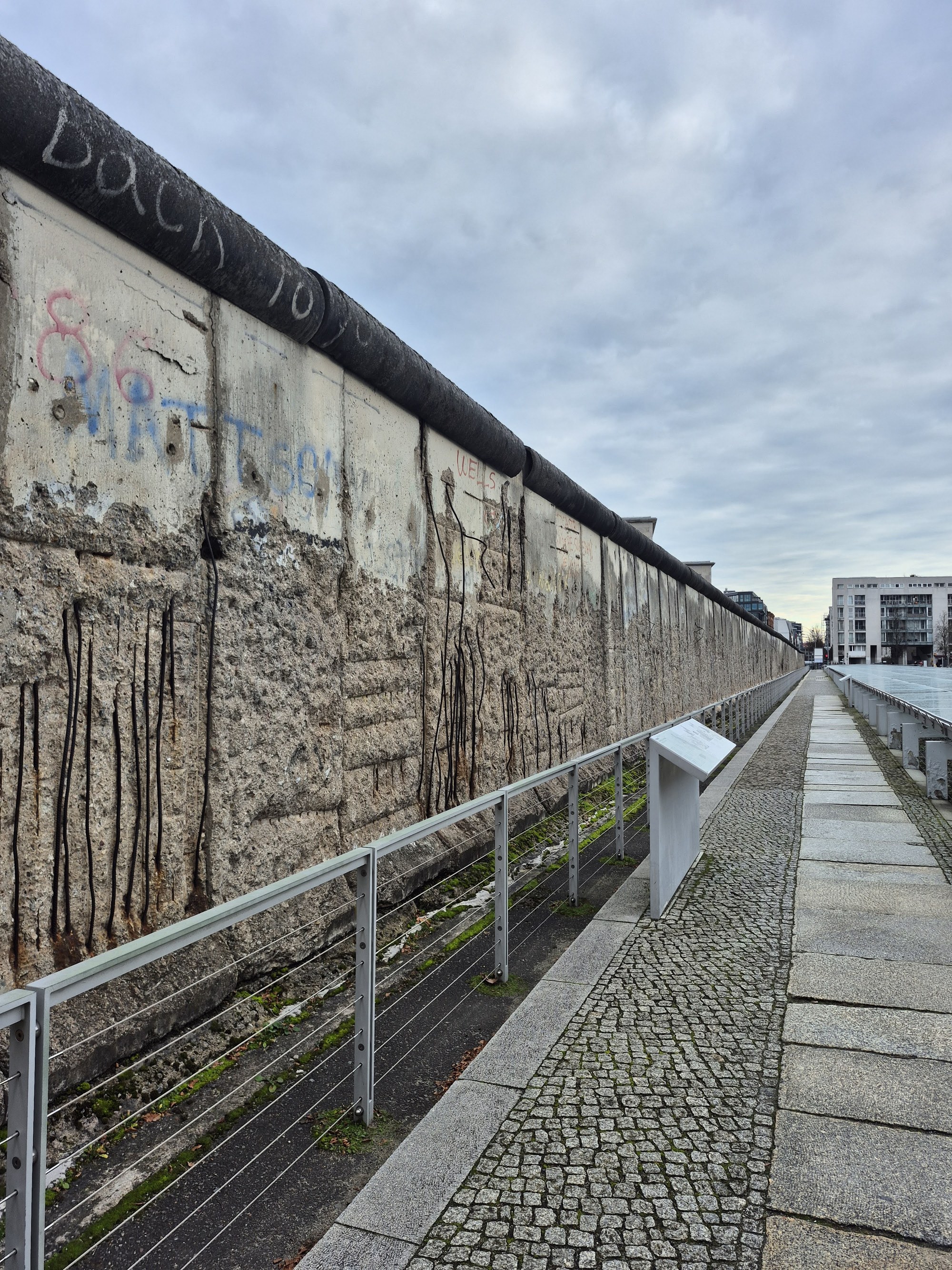
The Wall at the Topography of Terror — the Gestapo and SS headquarters site, kept as an open exhibition. Berlin confronts its history on purpose.
December also means Christmas markets. Gendarmenmarkt and the one by the Kaiser Wilhelm Memorial Church were the highlights — Glühwein stands, wooden stalls, that whole atmosphere. And I made it to Mass at Sankt Hedwig’s Cathedral, which ran in German and English — there’s something grounding about finding the same liturgy in a foreign language.
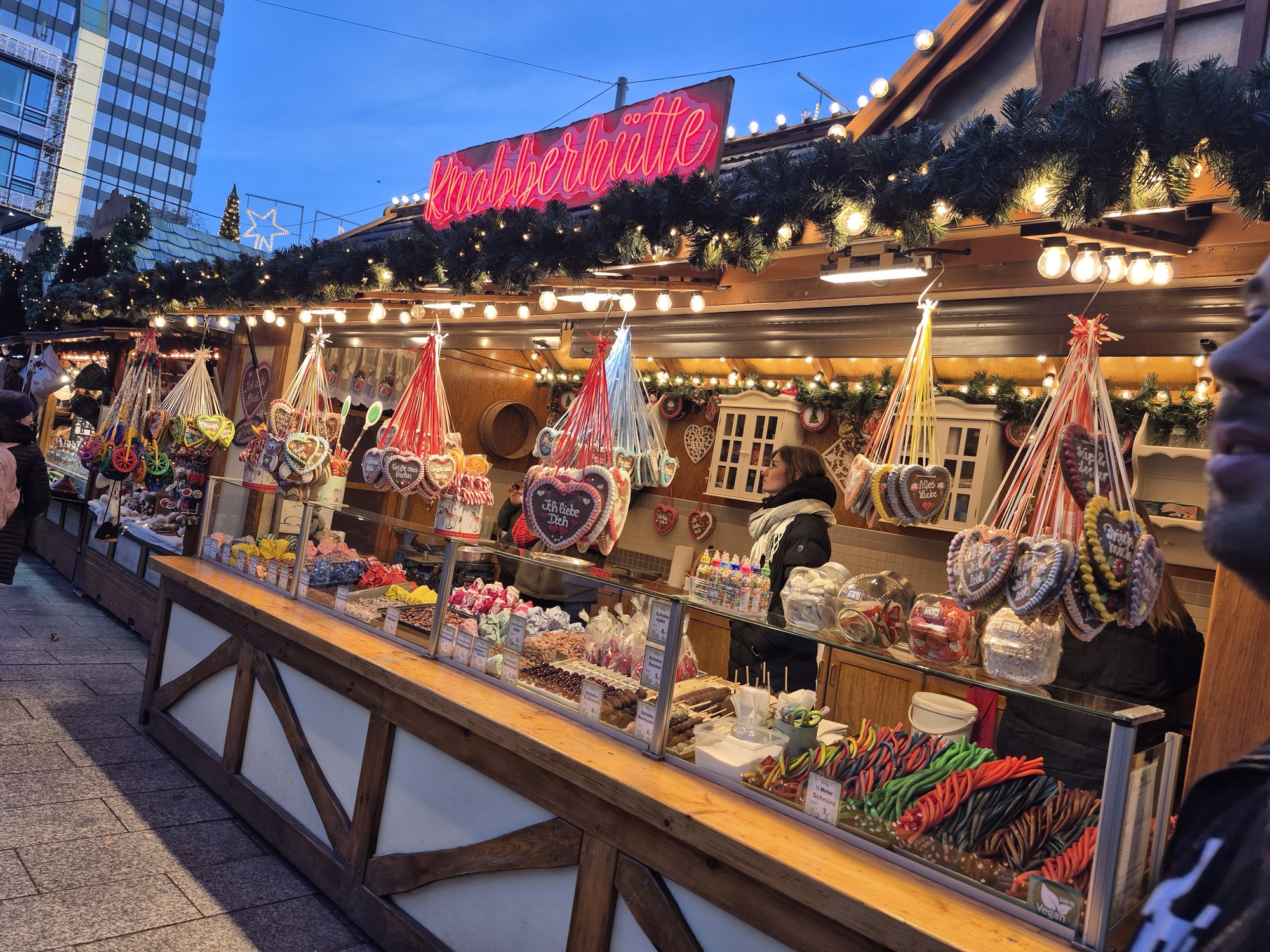
The Christmas market at Breitscheidplatz, beside the Kaiser Wilhelm Memorial Church — December in Berlin is dark by 4 PM, but the markets make up for it.
One of the best evenings had nothing to do with sights: I stayed a night with an old friend who now lives in Berlin, at his girlfriend’s cozy apartment, and we talked for hours. Old friends in new cities are one of travel’s best features.
Verdict
Berlin is “nice for starters” — genuinely good for a short visit, and I’m glad I went. But it’s not somewhere I’d want to live. What I took from it wasn’t a list of attractions; it was a question the whole city seems built around: how do people live under constraint, and what do they build after liberation? Every museum, mural, and reused factory is a different answer to that.
Next stop: Barcelona, where I finally got to travel like a tourist. That’s part two.
Practical notes
- December daylight is short (~7.5 hours). Plan outdoor things for midday.
- If it’s a work trip, accept that it’s a work trip. Add personal days at the end rather than pretending evenings will be enough.
- The Berlin WelcomeCard covers public transport plus discounts — worth it if you’re moving around a lot.
- Stay in Friedrichshain if you want the young, scruffy, street-art Berlin rather than the polished Mitte version.